
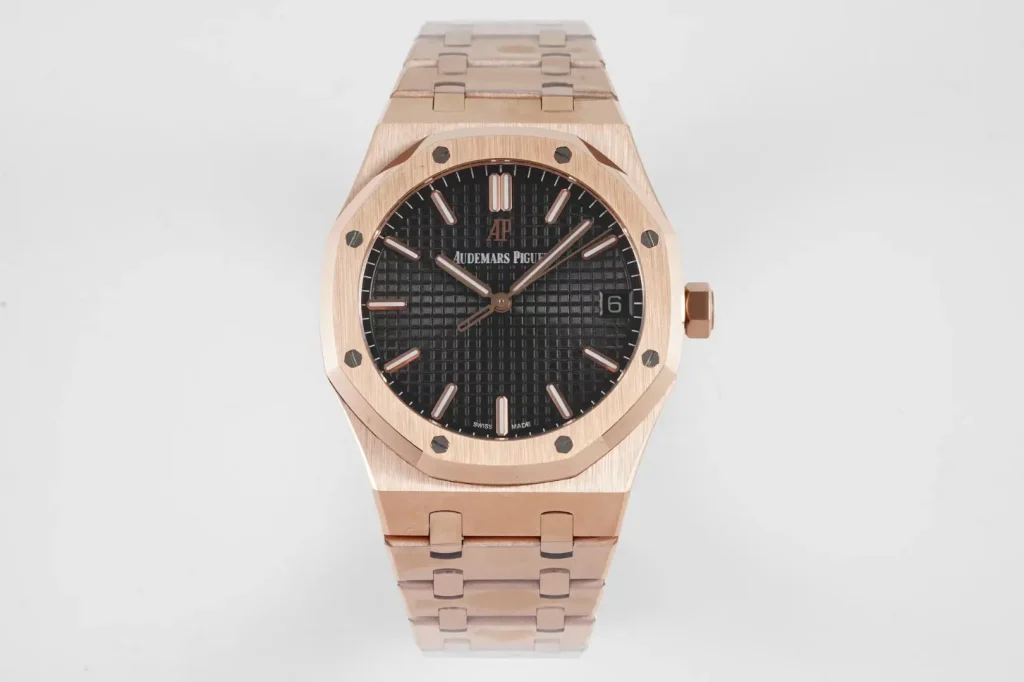
Of all the watches searched under the phrase audemars piguet royal oak replica, the Royal Oak stands alone as the original luxury steel sports watch that redefined an entire industry. Designed by Gérald Genta and launched in 1972, its octagonal bezel secured by eight hexagonal screws, integrated bracelet with contrasting finishes, and “Tapisserie” guilloché dial have become shorthand for audacious Swiss craftsmanship. Authentic Royal Oaks start around $28,000 for a basic steel 15500 and stretch far beyond that for discontinued references, gem-set pieces, or perpetual calendars. Consequently, the audemars piguet royal oak replicamarket has matured into one of the most sophisticated segments of the super clone industry. In this focused guide we break down the most popular Royal Oak replica references, the technical and aesthetic hallmarks of a top-tier RO replica, common pitfalls to avoid, and practical advice for selecting the right size and dial color for your wrist.
The most commonly replicated Royal Oak references include the 15450 (37mm, older mid-size discontinued in favor of the 15500), the 15500ST (41mm, three-hand with date at 3 o’clock, replaced the 15300/15400 lineage), the newer 16202ST (41mm, date at 3, updated movement aesthetics resembling the in-house 7121, no “QUICKSET DATE” text on dial), and the Royal Oak Chronograph 26331 (41mm, sub-dials at 3-6-9 with date between 4 and 5). Each has its devotees: the 15450 appeals to smaller wrists or those preferring a more compact profile; the 15500 is the current-production sweet spot for most men; the 16202 appeals to purists who want the latest reference look; and the Chronograph satisfies those needing chronometric functionality and a busier, sportier dial.
A convincing audemars piguet royal oak replicalives or dies by its finishing. The case should measure correctly—41mm for the 15500/16202 (excluding crown), ~9.8–10.4mm thick depending on generation—with a slim, elegantly tapered profile. The bezel’s eight hexagonal screws must be recessed properly and all oriented with slots parallel to the bezel edge; this single detail instantly separates decent replicas from junk. The brushed surfaces of the case and bracelet should have a uniform linear grain, while polished bevels need to be mirror-bright without orange peel. The dial’s Petite Tapisserie pattern consists of hundreds of tiny raised squares produced by a stamped die; under magnification they should have crisp edges and consistent spacing. Hour markers are applied, faceted, and typically rhodium-toned on steel models—they should catch the light from multiple angles. The date window must have a beveled frame and a white background with black numerals that match the dial’s font (not overly bold or misaligned). On the 15500, the date magnifies slightly via the cyclops-free flat crystal; the 16202 omits the “SWISS MADE” micro-print on some gens but replicas often retain it—minor variation acceptable at super clone level.
Bracelet assessment cannot be overstated for a Royal Oak. The integrated bracelet flows seamlessly from the case lugs, tapering to the deployant clasp. Link tops are brushed, sides are polished—a detail many cheap audemars piguet royal oak replicaattempts get wrong by brushing everything or using rounded rather than sharp bevels. The first center link is often slightly elevated; the H-shaped links should articulate smoothly without excessive rattle yet with enough flexibility for comfort. The hidden deployant clasp closes flush with the bracelet and bears the AP logo deeply engraved on the inner tab. Weight should feel reassuring—authentic 15500 on bracelet weighs approximately 142g; a good replica is within ±10g of that.
Movement visibility varies by model. Three-hand Royal Oaks typically have solid casebacks with engraved medallion; Chronographs and some limited editions feature display backs showing the movement. Super clone RO replicas may use Asian 3120 clones (decorated to show Geneva stripes, perlage, and a skeletonized rotor reminiscent of AP’s 2385 or 4302 aesthetics) or, more commonly on three-hand models, reliable decorated automatics based on Sellita/Swiss clone platforms with custom rotors. Functionally, the watch should keep acceptable time (±10–20 sec/day is typical for well-regulated clones) and the seconds hand should sweep smoothly.
Color selection deserves mention. Blue dial (reference 15500ST.OO.1220ST.03) is the quintessential Royal Oak look and the most popular audemars piguet royal oak replicachoice. Black dial offers understated elegance. White/silver dials with blue or black sub-dials on Chronographs create a stark, legible contrast. Smoked dials (burgundy, green, grey gradient) are also replicated from recent OEM releases and appeal to collectors wanting something distinctive.
When sourcing your audemars piguet royal oak replica, insist on detailed macro shots, confirm the exact reference being copied, ask about glass type (sapphire only), bracelet finishing method, and movement specification. A seller who can answer these questions knowledgeably is far more likely to deliver a product you’ll be happy with long-term.
The Royal Oak is more than a watch—it’s a design icon that challenged convention and won. Carrying a superbly executed replica lets you honor that spirit on your own terms, with none of the boutique gatekeeping. Choose quality, verify the details, and enjoy one of the most recognizable silhouettes in horology.